Explore Pressure Transmitters for Reliable Industrial Automation
Pressure measurement is an important part of many industrial processes. Factories, water treatment plants, chemical facilities, and energy systems often need to monitor the pressure of liquids and gases to maintain safe and consistent operations.
Even small changes in pressure can indicate a developing problem or a change in process conditions.

Pressure Transmitters help industrial systems measure pressure and convert it into an electrical signal that monitoring equipment or control systems can interpret. These instruments allow operators to observe process conditions, identify unusual readings, and adjust equipment when necessary.
They are commonly used in pipelines, storage tanks, pumps, compressors, boilers, and manufacturing equipment. Depending on the application, a pressure transmitter may measure the pressure of a gas, liquid, or process material under different operating conditions.
Understanding how these instruments work helps explain their role in industrial automation. This guide covers pressure transmitter types, operating principles, common applications, selection considerations, installation practices, and maintenance requirements.
What Are Pressure Transmitters?
Pressure transmitters are instruments that measure the pressure exerted by a gas or liquid and convert the measurement into a signal that another system can read. The signal is commonly transmitted to a programmable logic controller, distributed control system, display unit, or industrial monitoring platform.
Unlike a simple pressure gauge, which displays a reading locally, a transmitter can send pressure information to a separate control room or automated system. This makes it useful when operators need to monitor several locations or adjust processes based on measured conditions.
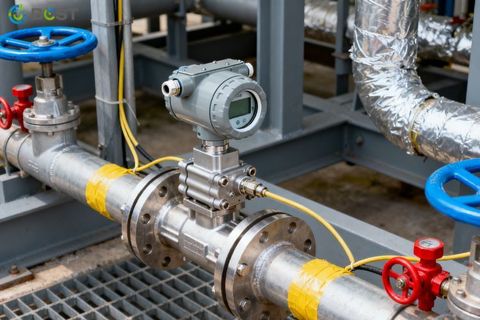
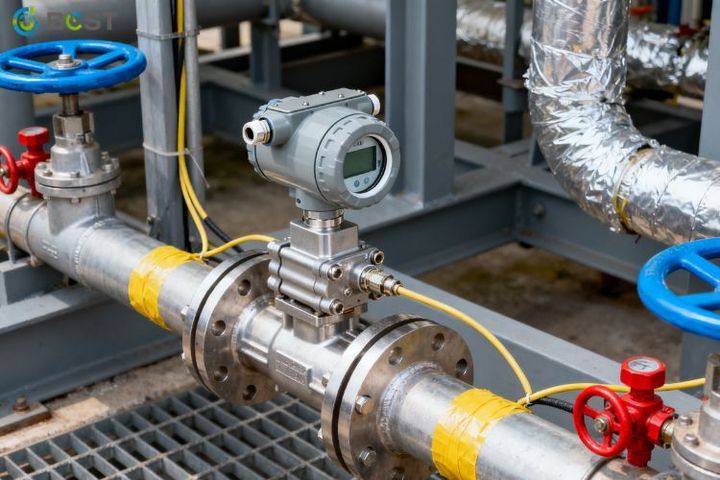
A typical pressure transmitter includes a pressure-sensing element, electronic circuitry, an enclosure, and an electrical connection. Some models also include a display or communication functions.
The instrument must be selected according to the pressure range, process temperature, material compatibility, environmental conditions, and required measurement accuracy.
How Do Pressure Transmitters Work?
Pressure transmitters follow a basic process: pressure reaches a sensing element, the element responds to the pressure, and electronic circuitry converts that response into a readable signal.
1. Pressure Detection
The process pressure acts on a sensing component, such as a diaphragm. The diaphragm may move slightly or experience a measurable change in its physical properties when pressure is applied.
The size and type of response depend on the transmitter's design and the pressure being measured.
2. Signal Conversion
The sensing element produces a change that can be detected by the instrument's electronics. Depending on the technology, this may involve changes in electrical resistance, capacitance, or another measurable property.
The electronics convert this response into a pressure value using the instrument's calibration settings.
3. Signal Transmission
Many industrial transmitters use a 4–20 mA current signal to communicate measurements to control equipment. Other models may use voltage signals or digital communication protocols.
For example, a transmitter configured for a pressure range of 0 to 10 bar may produce 4 mA at 0 bar and 20 mA at 10 bar. A reading of 12 mA would correspond to approximately 5 bar, assuming a linear response and correct calibration.
The control system can display this information, record it, or use it to adjust a process automatically.
Main Types of Pressure Transmitters
Different applications require different measurement methods. Understanding the main categories helps identify an appropriate instrument.
1. Gauge Pressure Transmitters
Gauge pressure transmitters measure pressure relative to the surrounding atmospheric pressure. They are commonly used in water pipelines, air compressors, pumps, and many industrial processes.
For example, a gauge pressure reading of 3 bar indicates that the measured pressure is 3 bar above the local atmospheric pressure.
These instruments are useful when the difference between process pressure and atmospheric pressure matters more than absolute pressure.
2. Absolute Pressure Transmitters
Absolute pressure transmitters measure pressure relative to a vacuum. They are used in applications where atmospheric pressure changes could affect the measurement.
Examples include vacuum systems, selected chemical processes, and equipment that requires accurate absolute pressure monitoring.
Because the reference point is a vacuum rather than the surrounding atmosphere, absolute pressure readings differ from gauge pressure readings.
3. Differential Pressure Transmitters
Differential pressure transmitters measure the difference between two pressure points. They have two pressure connections, commonly identified as high-pressure and low-pressure sides.
These instruments can monitor pressure drops across filters, measure liquid levels in certain closed tanks, and support flow measurement when used with an appropriate primary element.
A growing pressure difference across a filter, for instance, may indicate that the filter is becoming blocked.
4. Digital and Smart Pressure Transmitters
Smart transmitters include electronic functions that may support digital communication, configuration, diagnostics, and calibration information.
Depending on the model, technicians may be able to check instrument status or adjust settings through compatible tools.
These features can simplify maintenance and integration with industrial control systems, but the available functions depend on the transmitter and communication protocol.
Applications in Industrial Automation
Pressure transmitters are used in many industries because pressure affects how equipment and processes operate.
Water and wastewater treatment: Transmitters monitor pressure in pumping systems, distribution pipelines, filters, and treatment equipment. Measurements help operators identify changes in system conditions and investigate possible blockages or leaks.
Oil and gas: Pressure instruments monitor pipelines, storage systems, compressors, and process equipment. The selected transmitter must suit the operating pressure, temperature, materials, and hazardous-area requirements.
Chemical manufacturing: Pressure measurements help monitor reactors, tanks, pipes, and process vessels. Material compatibility is particularly important when the process involves corrosive or reactive substances.
Food and beverage production: Transmitters can monitor pressure in liquid processing systems, tanks, and pipelines. Hygienic design and appropriate cleaning compatibility may be necessary to prevent contamination.
Power generation: Pressure instruments monitor selected steam, water, fuel, and cooling systems. High-temperature or high-pressure applications require instruments specifically rated for the operating conditions.
Pharmaceutical production: Pressure monitoring may support liquid processing, filtration, and controlled manufacturing environments. Documentation, calibration, and hygienic requirements depend on the application.
In each industry, pressure measurements provide information that helps operators understand process conditions and respond to changes.
Benefits of Pressure Transmitters in Automation
Pressure transmitters support industrial operations by making process conditions easier to monitor and record.
Continuous measurement allows operators to identify pressure changes without relying entirely on manual readings. When connected to an automated control system, the measurement can trigger an alarm or support adjustments to pumps, valves, or compressors.
Recorded pressure data can also help maintenance teams investigate recurring problems. For example, repeated pressure drops may point toward a leak, a restriction, or a change in equipment performance.
Remote monitoring can reduce the need for personnel to visit every measurement point during routine checks. However, critical equipment still requires appropriate inspection, maintenance, and independent safety controls.
The value of pressure monitoring depends on correct installation, suitable instrument selection, accurate calibration, and appropriate interpretation of the readings.
How to Select the Right Pressure Transmitter
Selecting a pressure transmitter begins with understanding the process and its operating conditions.
First, determine whether the application requires gauge, absolute, or differential pressure measurement. Next, identify the normal operating pressure, expected pressure fluctuations, and any possible pressure spikes.
The transmitter's measurement range should suit the application without exposing the instrument to pressure beyond its rated limits.
Other factors include process temperature, fluid compatibility, vibration, moisture, electrical connections, and the environment in which the instrument will operate.
The required output signal must also be compatible with the control system. A facility using a 4–20 mA input, for example, needs a transmitter and wiring arrangement that support that signal.
For demanding applications, check the relevant accuracy specifications, calibration requirements, pressure ratings, and hazardous-area approvals. Consulting qualified instrumentation engineers can help ensure that the selected model meets technical and safety requirements.
Installation and Maintenance Considerations
Correct installation helps a pressure transmitter provide reliable measurements. The instrument should be installed at a suitable measurement point and connected according to the manufacturer's instructions.
Pressure connections must be compatible with the process and properly sealed. Incorrect fittings or damaged connections can lead to leakage or inaccurate readings.
In applications involving high temperatures, vibration, corrosive liquids, or pressure pulses, additional installation measures may be required. Differential pressure systems also need correctly arranged pressure lines to prevent measurement errors.
Maintenance generally includes inspecting connections, checking for physical damage, reviewing instrument diagnostics, and confirming that readings remain consistent with expected process conditions.
Calibration should be performed according to the manufacturer's recommendations and the importance of the measurement. If readings become unstable or differ from a trusted reference, the instrument may require further investigation.
Any work on pressurized equipment must follow appropriate isolation and safety procedures. A transmitter should never be removed from a live pressure line unless the system has been specifically designed for that procedure and suitable controls are in place.
Conclusion
Pressure Transmitters play an important role in industrial automation by converting pressure measurements into signals that monitoring and control systems can interpret. They help track conditions in pipelines, tanks, pumps, processing equipment, and many other industrial applications.
Gauge, absolute, differential, and smart transmitters serve different measurement needs. Choosing the appropriate type requires careful attention to pressure range, process conditions, signal compatibility, and safety requirements.
With suitable installation, calibration, and maintenance, pressure transmitters can support accurate process monitoring and informed operational decisions. Their measurements remain an important part of managing industrial equipment safely and consistently.